
July 16, 2026 | Blog
Alberta’s breathtaking landscapes are home to a diversity of wildlife. But as our province grows and changes, so does the challenge of coexisting with the creatures that share this land with us. Human activities, from urban expansion to agriculture, leave a significant footprint, shrinking habitats, and fragmenting ecosystems. The good news? Even in our own backyards, we can take steps to support wildlife and foster biodiversity.
Using data from the Alberta Biodiversity Monitoring Institute (ABMI), we can see just how widespread our human footprint has become. But with awareness and action, we can create spaces where wildlife not only survives but thrives.
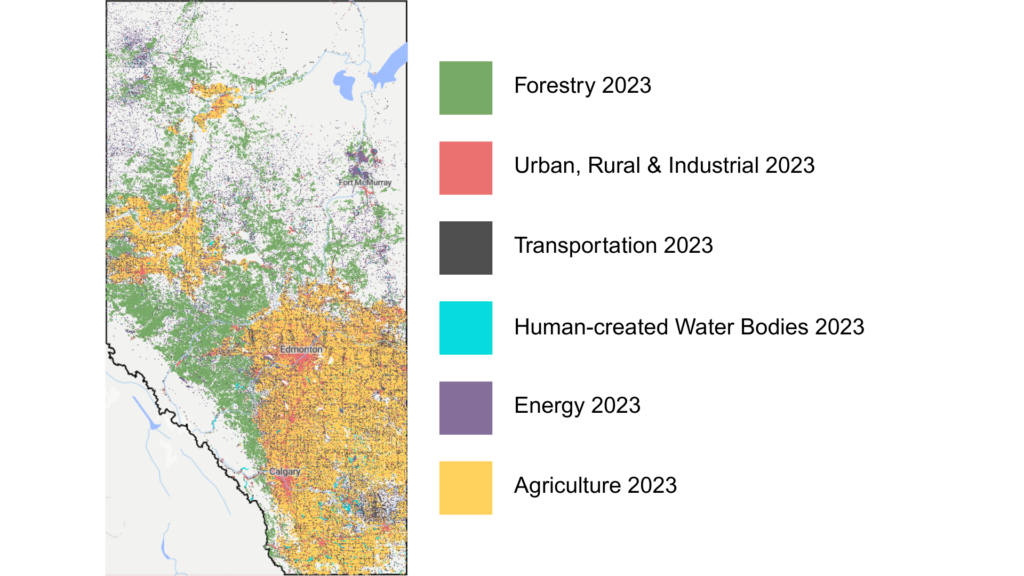
Table 1: Map of Alberta with Human Footprint 2023 data overlaid. Human footprint includes Forestry, Urban, Rural & Industrial, Transportation, Human-created Water Bodies, Energy, and Agriculture.
The Human Footprint: A Shrinking Habitat for Wildlife
Human activities such as forestry, urban development, transportation, and agriculture have transformed Alberta’s landscapes. The ABMI’s mapping tool reveals the extent of this footprint, highlighting how much of our province is now influenced by human presence.
One of the most critical concerns is the loss of interior native habitat. There are areas far enough from human disturbances to minimize edge effects (changes in environmental conditions at the boundary between natural and disturbed areas). These habitats are essential for wildlife to live, breed, and thrive without the pressures of urbanization.
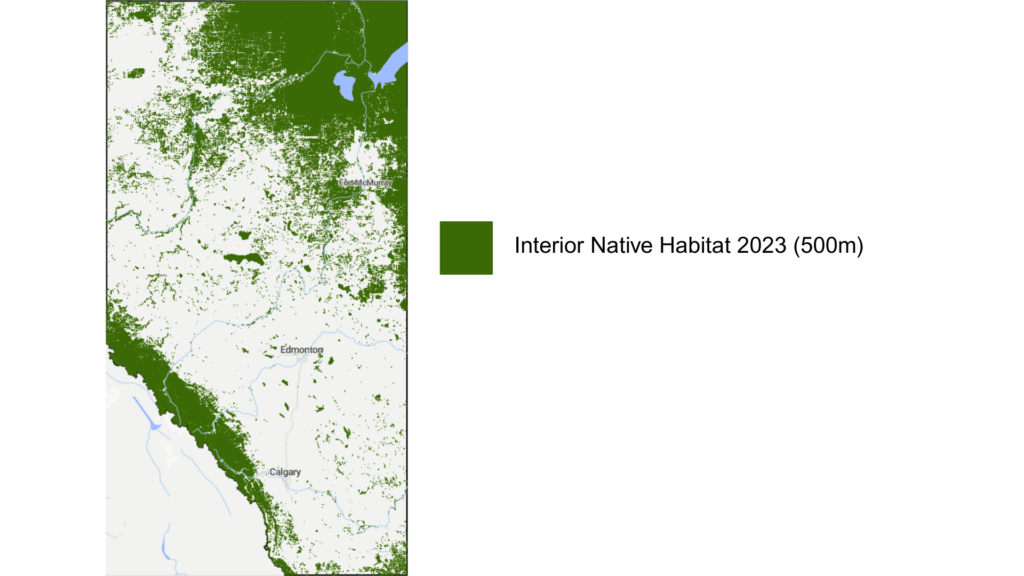
Table 2: Map of Alberta with interior native habitat (500m from human disturbance) 2023 data overlaid.
While much of this interior habitat is concentrated in protected areas, there’s hope for wildlife even outside these zones. By making thoughtful choices in our own backyards, we can help bridge the gap and create corridors for wildlife to move, feed, and shelter.
Xeriscaping: A Win-Win for You and Wildlife
Transforming your yard into a wildlife-friendly haven doesn’t have to be complicated or expensive. Xeriscaping, a landscaping approach designed to use less water and require minimal maintenance, is a perfect solution. Not only does it save you time and money in the long run, but it also provides critical support for local ecosystems.
Here’s how you can get started:
1. Water Wisely
Water in the morning after the morning dew has dried to reduce evaporation. Avoid overwatering plants as it encourages focus on growth rather than building energy reserves. Collect rainwater for irrigation to reduce stormwater runoff. Just ensure your rain barrel has a tight-fitting lid or screen to prevent mosquitoes from breeding.
2. Reduce Lawn Space
Embrace patios, rock gardens, and native plants to minimize lawn area. Lawns offer little ecological value, while native plants provide food and shelter for wildlife. Native plants are drought-resistant, require less water, and don’t need annual replanting. They also support local insects, birds, and other wildlife by providing food and shelter.
3. Options for Native Plants
Here are four easy-to-grow native plants that will attract bees, butterflies, and hummingbirds to your yard:
- Agastache foeniculum, commonly known as Blue Giant Hyssop, Lavender Hyssop, Anise Hyssop or Fragrant Giant Hyssop. The number one pick for bees. You can eat the flowers and it’s self-seeding.
- Helianthus nuttallii, commonly known as Nuttall’s Sunflower, Common Tall Sunflower. It is enjoyed by bees and is self-seeding.
- Gaillardia aristata, commonly known as Indian Blanket, Firewheel, Girasol Rojo, or just Gaillardia. It is loved by bees and is very colorful.
- Liatris ligulistylis, commonly known as Rocky Mountain Blazing Star, Rocky Mountain Gayfeather, Rocky Mountain Liatris, Meadow Blazing Star, Meadow Gayfeather, and Meadow Liatris. It is beloved by butterflies.
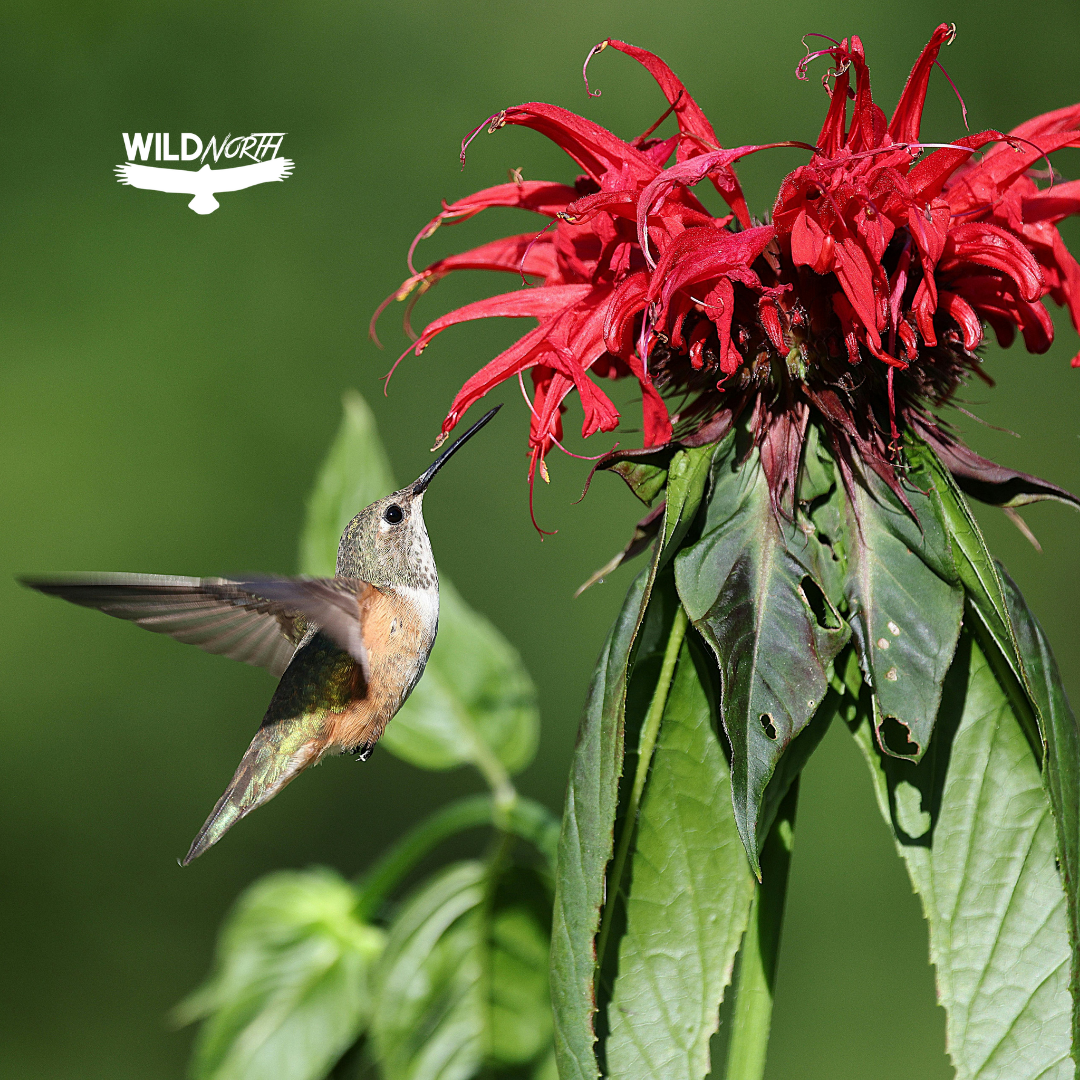
- Monarda fistulosa, commonly known as Wild Bergamot or Beebalm. It not only attracts butterflies, but also hummingbirds too.
For more options, check out the Edmonton Native Plant Society’s resources at https://www.enps.ca/resources.
Other techniques can be used to help cultivate an environment for our insects
1. Apply mulch in the spring
It smothers weeds and in fall to help insulate the ground for burrowing insects.
2. “Leave the leaves”
Keep fallen leaves in your yard until May to insulate your lawns for those same insects, especially native bees that nestle in leaf litter during the winter.
3.Pesticides run off with water
Avoid using pesticides where possible, especially near bodies of water where many insects make their home. It may eventually spread and kill more insects than intended.
Why focus on insects? They’re the foundation of our ecosystems. Many birds, including aerial insectivores (birds that catch insects in the air), are in decline due to habitat loss, pesticide use, and climate change. In fact, studies show that aerial insectivores have declined by 59% in Canada since the 1970s (Nebel et al. 2020).
A Call to Action: Every Action Counts
The decline of insects and birds isn’t just a problem for wildlife, it’s a sign that our ecosystems are struggling. But the good news is that every one of us can make a difference. By adopting even a few of these practices, you can:
Support declining species like bees, butterflies, and birds.
Reduce your water usage and save money.
Create a beautiful, low-maintenance yard that benefits both you and nature.
Nature is interconnected. When we help insects, we help birds. When we help birds, we help the entire ecosystem. Let’s work together to ensure Alberta’s wildlife has a thriving future, one backyard at a time.
Sources and citations:
ABMI. 2026 Apr. Status of Land Cover & Biodiversity in the Oil Sands Region. Status of Land Cover and Biodiversity in the Oil Sands Region Assessment of status and trends in land cover, species, and habitat. [accessed 2026 July 13]. https://osr-report-2026.abmi.ca/osr-home.html.
Eco-Landscaping | City of Edmonton. 2026. Edmontonca. [accessed 2026 July 13]. https://www.edmonton.ca/residential_neighbourhoods/gardens_lawns_trees/eco-landscaping.
Nebel S, Casey J, Cyr M-A, Kardynal KJ, Krebs EA, Purves EF, Bélisle M, Brigham RM, Knight EC, Morrissey C, et al. 2020. Falling through the policy cracks: implementing a roadmap to conserve aerial insectivores in North America. Avian Conservation and Ecology. 15(1). doi:https://doi.org/10.5751/ace-01618-150123.