
May 15, 2026 | Blog
A Second Chance: Reuniting Great Horned Owls in Edmonton, AB
Written by Damek Rivera, WILDNorth Wildlife Technician
An Icon of Our Province
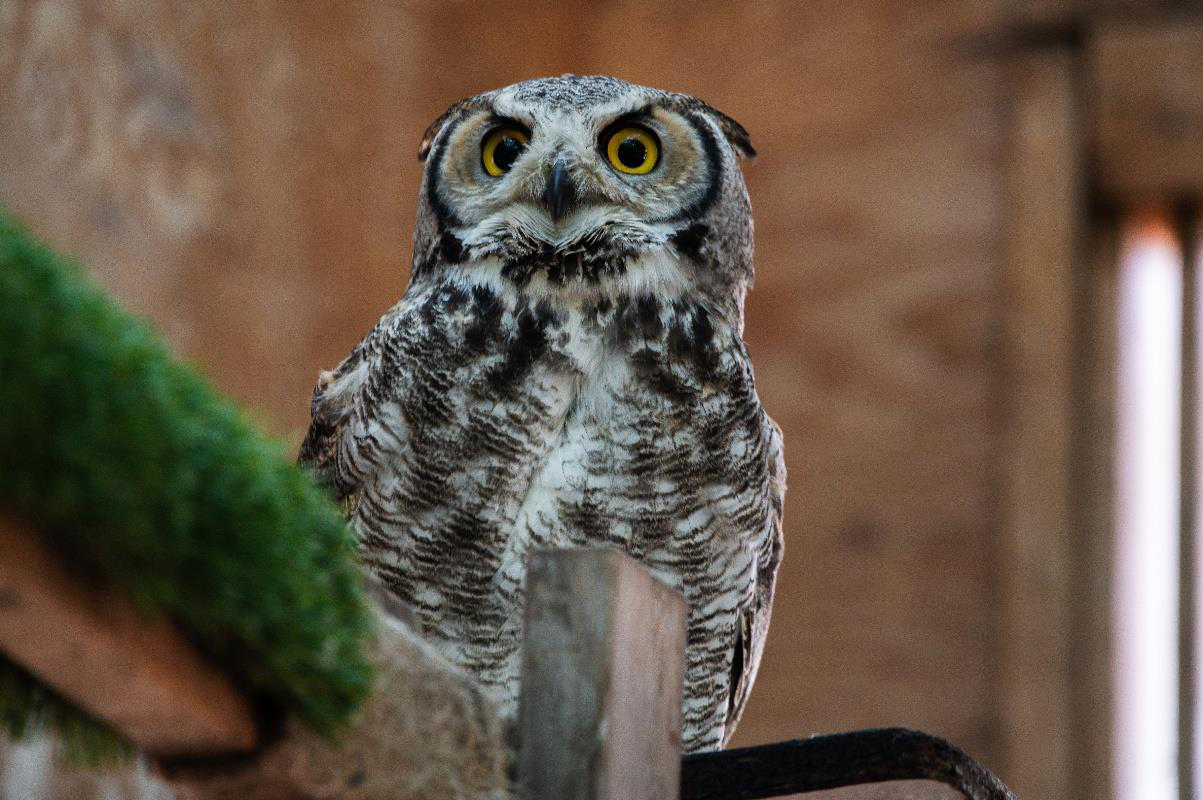
Alberta’s Provincial bird, the Great Horned Owl (Bubo virginianus), is one of WILDNorth’s most commonly admitted raptors. They are among the largest owls in Canada and possess one of the most extensive ranges, as well as the greatest variability in nest sites, across both North and South America (Birds of the World, 2026). Additionally, this species does not migrate annually, and most individuals remain permanent residents within their respective territories. Great Horned Owls are generally considered monogamous, with no evidence of polygamy detected (Rohner, 1997). While there is limited data regarding pair bonds, pairs may remain together for at least five years, and perhaps even for life. If a mate is lost during breeding season, research suggests a new adult may replace them anywhere from three weeks to four months later (Rohner, 1995). Outside of nesting season, this species is typically solitary, though pairs may continue occupying the same territory year-round. In Alberta, Great Horned Owls have historically begun nesting anywhere from January 28th to May 11th, with the average date being March 7th (Priestly, 2005). For this reason, they are often among WILDNorth’s very first babies of the year.
A Nest in the Middle of the City
This story begins in February 2026, when a well-known pair of owls once again decided to nest within a popular city park, where trails are heavily used every single day. This year, however, the pair chose against their historically preferred nest site and instead tried their odds at another location they had only occasionally used in the past. By the end of the month, they had successfully hatched two newborn owlets, each weighing no more than 50 grams, or about the weight of 60 paper clips. At this age, mom had one incredibly important job: keep those babies safe and warm. Dad, meanwhile, was responsible for ensuring mom and the owlets stayed well fed. Over the next four weeks, the owlets grew exponentially fast, gaining approximately 33 grams per day ( Browning & Banks, 1990). With every passing day the family became increasingly conspicuous. Mom also no longer needed to brood, or sit on, the babies nearly as often, as they had grown older and no longer relied heavily on her body heat. All of these factors led to something almost inevitable in such a heavily visited location: constant public attention directed towards this family of four.
When One Owl Fell
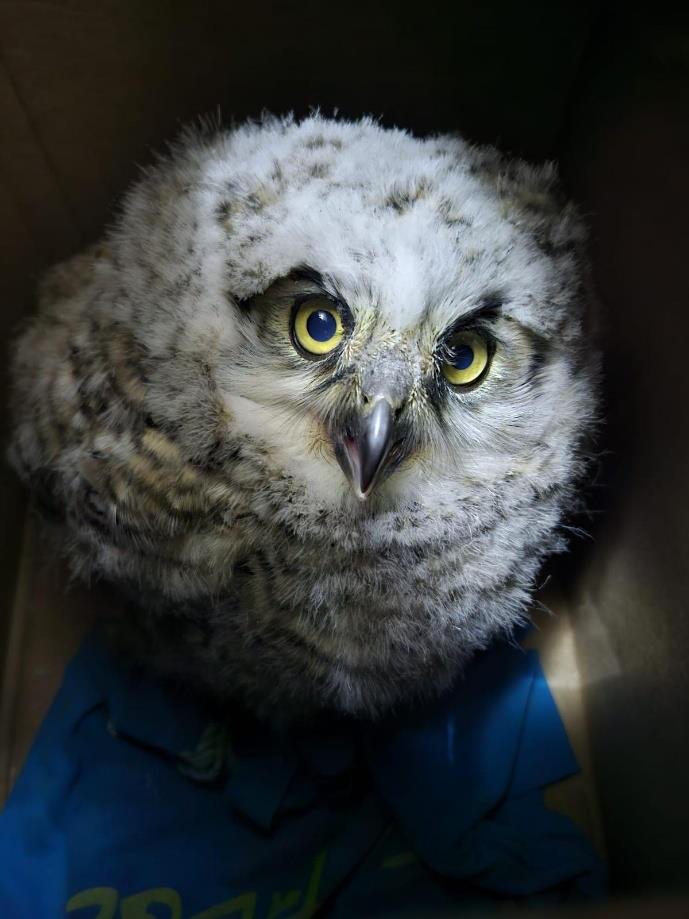
The excessive noise, attention, and overall disturbance are unfortunately things owls nesting in this forest have been somewhat accustomed to. However, when combined with the already difficult task of raising young owls, it has often resulted in the loss of nestlings. This brings us to early April 2026, when the younger of the two owlets was discovered grounded directly below the nest. Naturally, this immediately attracted considerable public attention, with many members of the public understandably concerned for the owl’s welfare. The silver lining is that, thankfully, among the many visitors to this forest is an incredible group of people who deeply appreciate its wildlife and observe it respectfully from a distance. During one of these occasions, WILDNorth first received notice about these owlets. A member of the public acted quickly and contacted our Wildlife Helpline. After discussion, it was determined that the owl was far too young to be out of the nest, especially on the ground where, at that age, it was completely defenseless and unable to escape threats. The owlet was admitted as patient GHOW 26-217 later that evening and was estimated to be approximately 35 days old. Fortunately, a physical examination by one of our Wildlife Technicians determined the individual was completely healthy, simply too young to have left the nest.
In situations like this, our first approach is always to attempt reunification through physical re-nesting. Our WILDCare team consulted external professionals with extensive experience re-nesting this species. Unfortunately, after careful consideration, we determined that re-nesting was not a safe option. That year, the nest was located within the snag of a large broken tree, making it extremely unstable and unsafe to climb. Instead, it was decided we would temporarily hold the patient in care and attempt reunification once they were older and better equipped to escape possible threats. For this owlet, its world had changed overnight. It was used to always having its sibling, mom, and dad nearby, with constant care and attention. Suddenly, all of that was gone. Now under our care, we did our best to provide an appropriate diet, temperature, and enclosure while minimizing stress and encouraging natural behaviors. Still, no matter how hard we try, we will never do as good a job as their parents can.
Staying Wild in Human Care
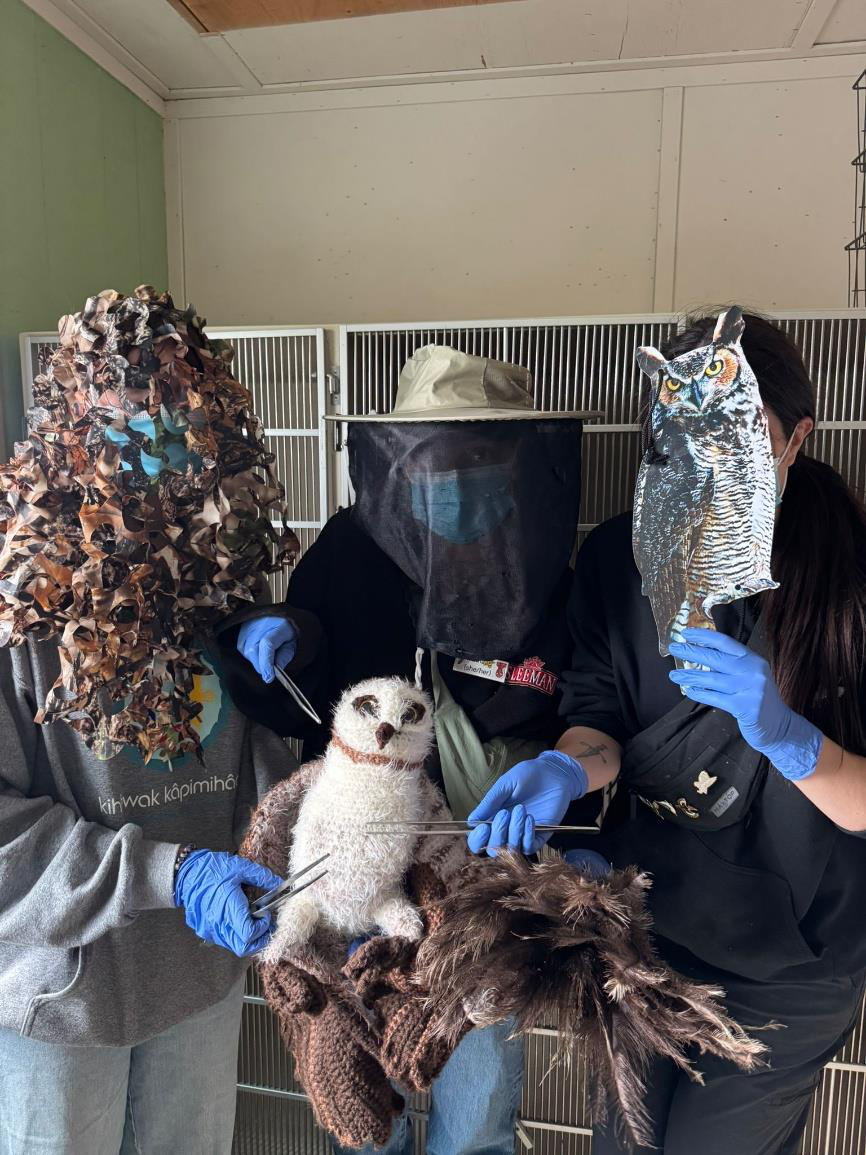
In wildlife rehabilitation, the goal is always release, whether back into the wild or away from current and future suffering. One incredibly important challenge we deal with daily, particularly with some species more than others, is habituation. Young raptors are known to habituate extremely easily, which means we must be very careful with how we interact with them during rehabilitation. For our staff and volunteers, this meant strict compliance with complete silence, visual barriers, mirrors, owls stuffies, and face coverings. Thankfully, these methods were highly effective, and I can safely say this owlet had absolutely no interest in becoming my friend at any point during its rehabilitation journey.
Another Calls Comes In
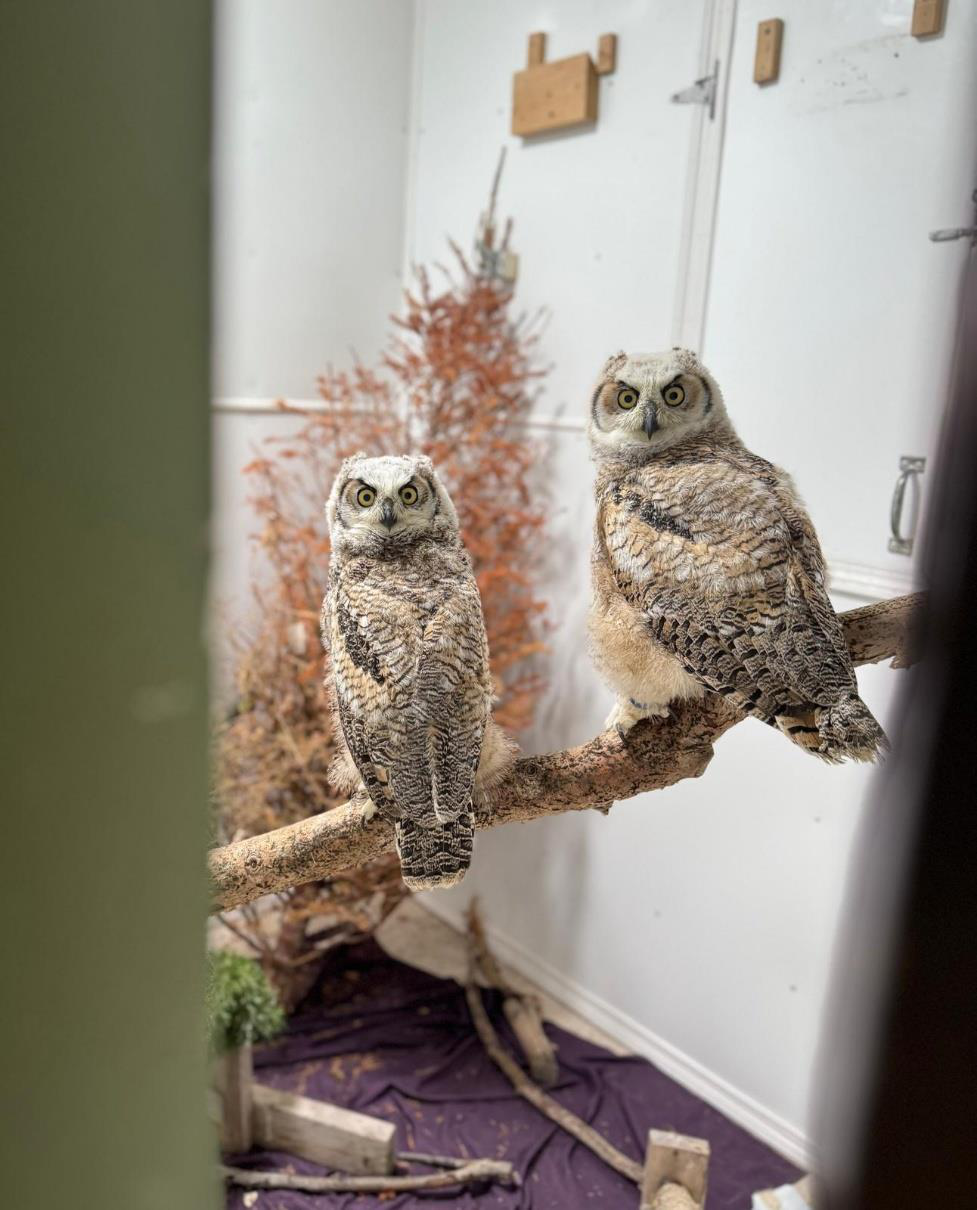
After a week in care, patient 26-217 was developing well and beginning to practice self-feeding. This was an important milestone, as it would allow us to further reduce direct interaction. Up until that point, meals were still needed to be offered using tweezers. Then, on April 10th, 2026, our Helpline was notified that the second owlet from the nesting pair had also been found on the ground, once again far too young to fend for itself. Our WILDRescue team, acted quickly and made sure the second baby was admitted into our care. The two owlets were reunited almost immediately, and their connection was instant. More natural behaviors began to be displayed right away. They appeared brighter, more alert, and significantly more active. They even began self-feeding on dead prey from time to time. Although both still required close monitoring, but they were doing remarkably well in care. Every day they gained weight, grew more flight feathers, and became increasingly steady on their feet.
This was all excellent news, but it also raised one enormous concern, along with countless questions that, frankly, may never truly be answered with full confidence: Would the parents remain at the nest site? If so, for how long? If not, could we still locate and reunite them? Would the adults recognize the owlets as their own after that much time apart? What was our deadline? Would we need to raise these birds until full independence?
Those were only some of the questions constantly running through my mind as we attempted to determine the best path forward. One thing, however, was certain: these two were growing quickly. And a decision needed to be made soon. Would we raise them ourselves, or attempt an uncertain reunification?
A Search and Reconnaissance
After nearly a month in care, both owlets were now just over eight weeks old. At this stage, they were capable of finding dead prey, swallowing it whole, jumping, climbing, and even performing short flights with considerable lift. Now that I was confident that they would escape terrestrial threats and, most importantly, move away from human disturbance, it was finally time to decide between raising or reunification. Once again, these animals will always do better with their own kind, and there are significant risks associated with raising large raptors in enclosed environments for extended periods of time. For that reason, it was in both their best interest, and ours, to attempt reunification.
There was just one major problem: we had absolutely no idea whether the parents were still present. There was only one way to find out.
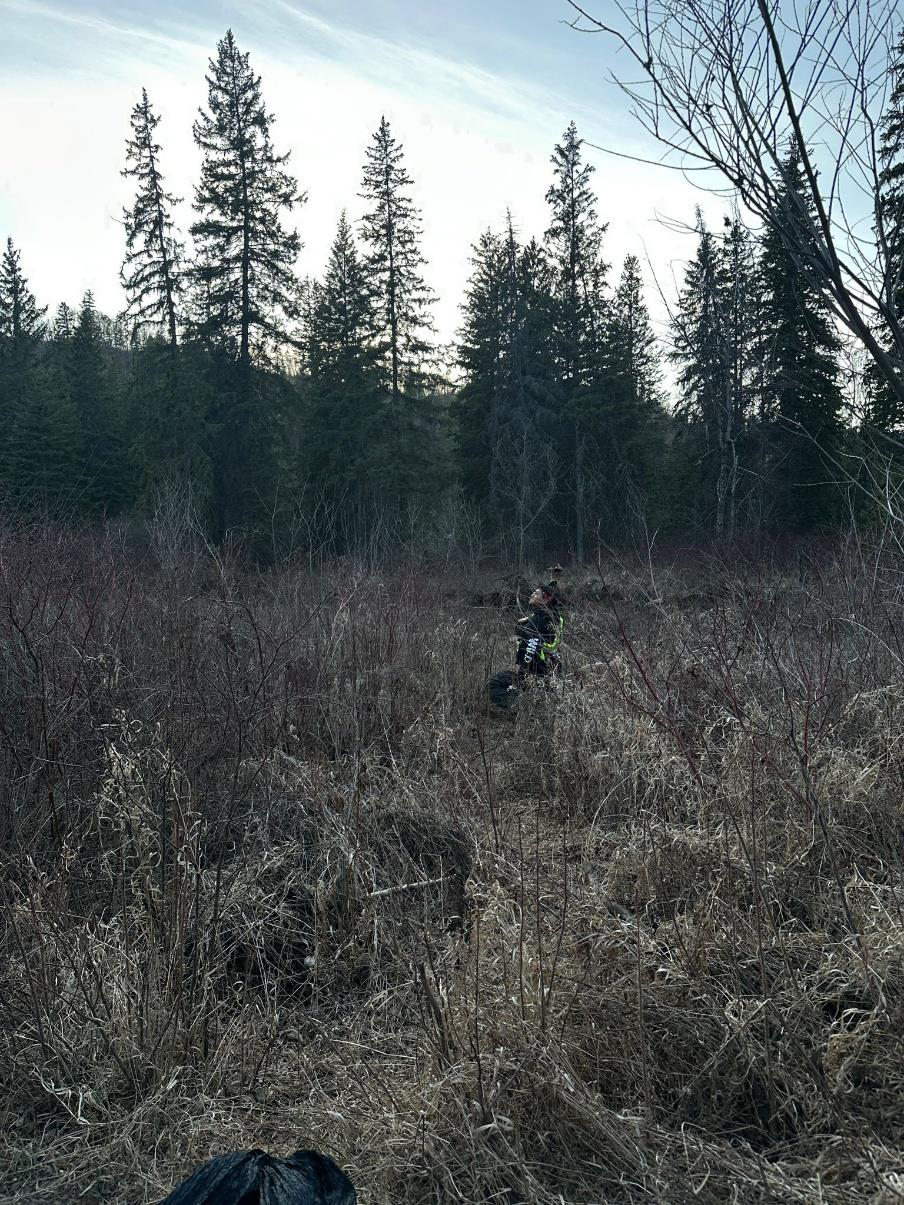
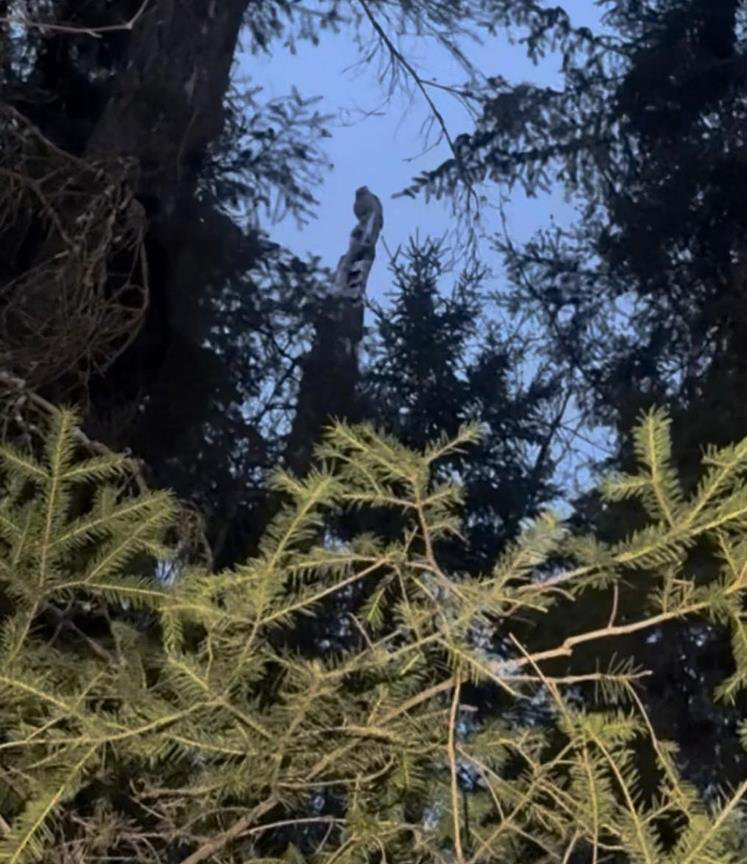
We headed out on a reconnaissance mission to hopefully locate the adults back near their nest site. We first searched during the late afternoon, but after several hours of scanning and listening, we had no luck. I decided to return closer to dusk and try again. Unfortunately, we still neither saw nor heard an owl near the original nesting area. As we were preparing to call it quits for the evening, I decided to take one final walk toward another area where we knew this pair had nested in previous years and even historically preferred. Once we arrived, it almost felt like it was meant to be. After nearly six hours of searching, just as I was beginning to feel discouraged, I happened to look in exactly the right place at the right time. Finally, perched high within a Trembling Aspen, stood an adult Great Horned Owl.
The relief we felt in that moment was enormous. But finding them was only the easy part.
An Uncertain Approach
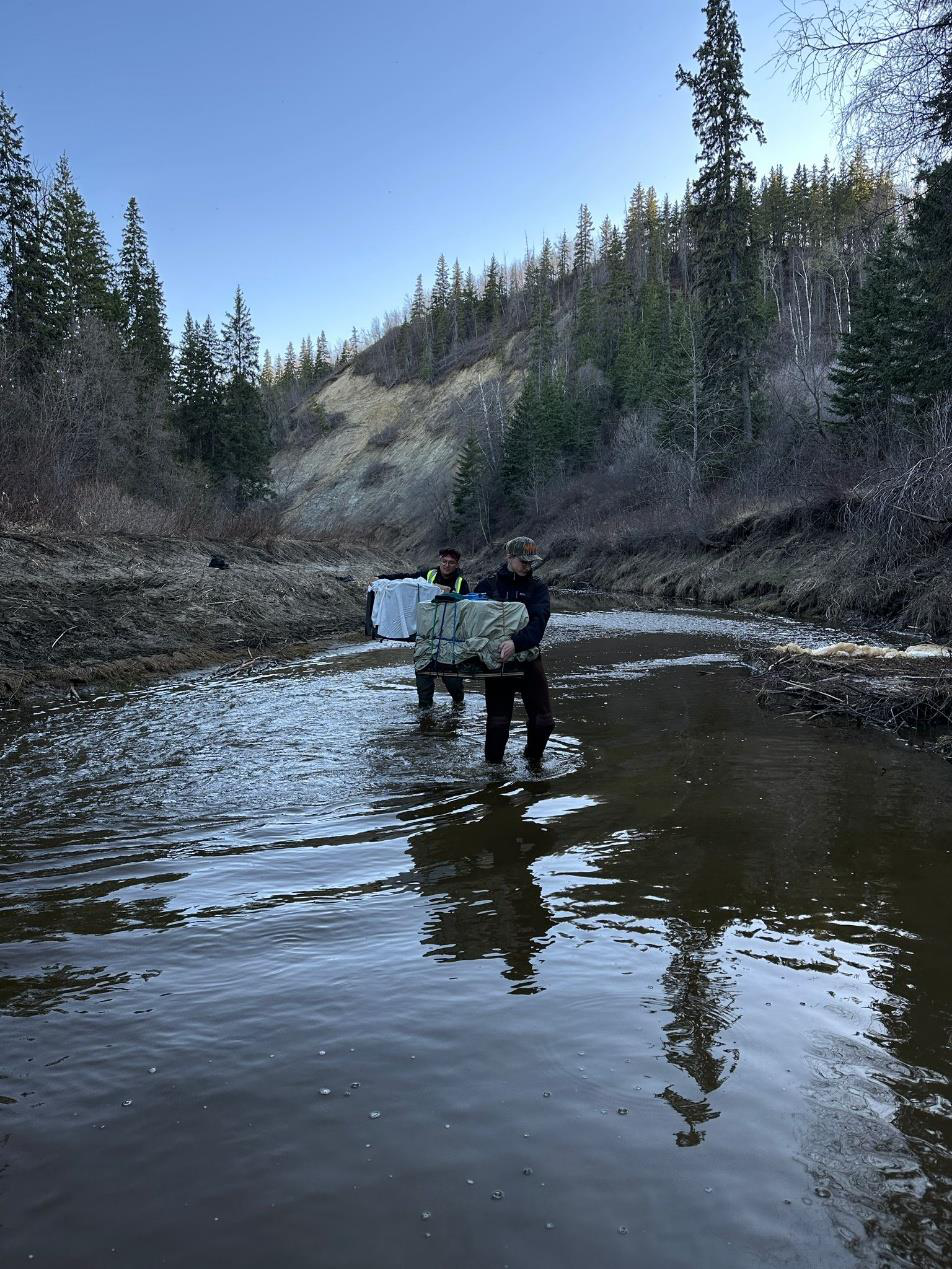
On May 5th, just over four weeks after our first owlet entered care, Max Buchanan, Chloe Englert, and I set out on a mission to reunite both patient GHOW 26-217 and GHOW 26-237 with their parents. Typically, when we reunite young owls, they are still flightless and relatively unstable on their feet, which makes it much easier to ensure they remain close to the nest area after release. In our case, however, these two were already fully flighted. And, because our habituation prevention methods had been so successful throughout rehabilitation, they were absolutely terrified of us. Simply releasing them and hoping they would fly toward their parents was not a feasible option.
So, this became our approach:
- Find a visible, open area ideally away from busy trails where the parents would be likely to easily spot the young.
- Using a barred, see-through dog kennel, we placed the older owlet inside and moved ourselves a considerable distance away to avoid disturbing the adults or discouraging them from approaching. Normally, we would only use soft-sided carriers in order to protect their feathers, but in this case, we made an exception to increase the likelihood of detection.
- Using playback recordings, we attempted to lure in adults with both begging calls from young Great Horned Owls and territorial calls from alternate adults.
If the parents approached and showed interest without signs of aggression, such as beak clacking towards the young, or vice versa, the owlets would then be released towards them.
Disclaimer: We do not recommend the use of playback on birds, especially wild birds during breeding season. Frequent playback can have several negative impacts. Playback should only be used by licensed researchers or wildlife rehabilitators when it is utilized for the benefit of the animal, not the observer. Click here for more information.
The Reunion
Following this strategy closely, we were able to observe some truly remarkable behaviors from this family of Great Horned Owls. Using playback, we first managed to lure in the female, who appeared very interested in investigating the “competitor” calls echoing through the forest. Shortly afterward, we saw what I assumed was the male following behind her, the size difference between the two obvious to the watchful eye. Somebody else, however, arrived even earlier to the party: a Common Raven, who clearly had strong opinions about the sounds we were broadcasting into the forest. Once the parents arrived, though, I witnessed some of the most fascinating behavior I have ever personally observed from this species. Initially, the Raven immediately began harassing the female owl, who was more than willing to fight back and assert dominance. But then she spotted the owlet. Almost instantly, the owlet began vocalizing begging calls towards her. Even now, writing about it still brings a tear to my eye. It was a type of vocalization I had never once heard while they were in care. Owlets are generally excellent eaters and will readily accept food from tweezers, but never once had either of them begged us for food the way they did towards their mother. It was an incredibly beautiful moment, and the instant I heard it, I knew they were going to be okay. There was still one problem, however: that Raven needed to be driven away so the young could have the parents undivided attention upon their release. This was where dad took charge.
While some of this may certainly be open to interpretation, what I observed in that forest was genuinely fascinating. While the female initially focuses on confronting the Raven. The male remained perched at a distance, hooting repeatedly. But the moment the owlets began calling toward the adults, the female shifted her attention back toward the young, and the male suddenly dove across the treeline directly at the Raven. The two disappeared into the forest briefly, the Raven loudly chasing behind him the entire way. Eventually, the male perched farther off while the Raven continued yelling in his ear from nearby branches. All the while, the female remained near patient 26-237, watching closely over the young. Eventually, the male succeeded in driving the Raven away entirely. This was our chance.
We released both owlets simultaneously, though exactly as expected, they immediately panicked and flew off in separating directions. By that point, however, our job was done. The two adult Great Horned Owls quickly pursued both babies and kept them in check. At that moment, we decided to leave the area and finally give this family the break from human disturbance they so desperately deserved.
Post-Release Monitoring
Even though our work was technically finished, we still wanted to monitor the family’s well-being following release. I reached out to Wayne Oakes, a highly respected naturalist who cares deeply for our natural world and humbly asked whether he would be willing to keep and eye (and ear) out for these owls. Generously, he was more than happy to help. After several days of monitoring, we were thrilled to confirm that our efforts had been successful. Both patient 26-217 and 26-237 had been successfully reunited with their parents after over an entire month apart. For this Great Horned Owl family, the story thankfully had a happy ending. Mom and dad got their babies back, and the two young owls that had fallen out of their tree, were given another chance to grow up wild, exactly where they belong.
How You Can Help Wild Owls
If you ever encounter an owl in the wild, please give it plenty of respectful space, especially during nesting season. Human disturbance can place enormous stress on nesting birds and may unintentionally put young owls at risk. If you do find an owl on the ground, do not automatically assume it has been abandoned or needs rescuing. Instead, contact WILDNorth’s Wildlife Helpline at 780-914-4118 for guidance before intervening.
Sources:
- Artuso, C., Houston, C. S., Smith, D. G., & Rohner, C. (2013). Great Horned Owl (Bubo virginianus), version 1.0. In Birds of the World. Cornell Lab of Ornithology. https://birdsoftheworld-org.proxy.birdsoftheworld.org/bow/species/grhowl/cur/introduction
- Rohner, C. (1997). Non-territorial ‘floaters’ in Great Horned Owls: space use during a cyclic peak of snowshoe hares. Animal Behaviour 53:901-912.
- Rohner, C. (1995). Great Horned Owls and snowshoe hares: what causes the time lag in the numerical response of predators to cyclic prey? Oikos 74:61-68.
- Priestley, L. (2005). Phenology of three raptor species in central Alberta based on nest banding records. Blue Jay 63 (1):26-30.
- Priestley, L. (2005). Phenology of three raptor species in central Alberta based on nest banding records. Blue Jay 63 (1):26-30.